Free & open source
Comity Intuition
Your AI's gut check before you ship.
When Claude Code or Codex finishes a task, a copy of that same agent reviews the work with fresh eyes and tells you, in plain English, whether it's safe to ship.
npx comity-intuition initA verdict anyone can read. Every time your agent says "Done!", you get what changed, what could go wrong for the business, and what to ask a developer. No jargon.
- Safe to ship
Nothing in this change needs a second look. Small, safe changes get a short review.
- Ask a developer about X
One specific thing deserves a developer's eyes before it goes live, and Intuition names it.
- Don't ship yet
A serious problem the reviewer is confident about, explained in terms of your product and your users.
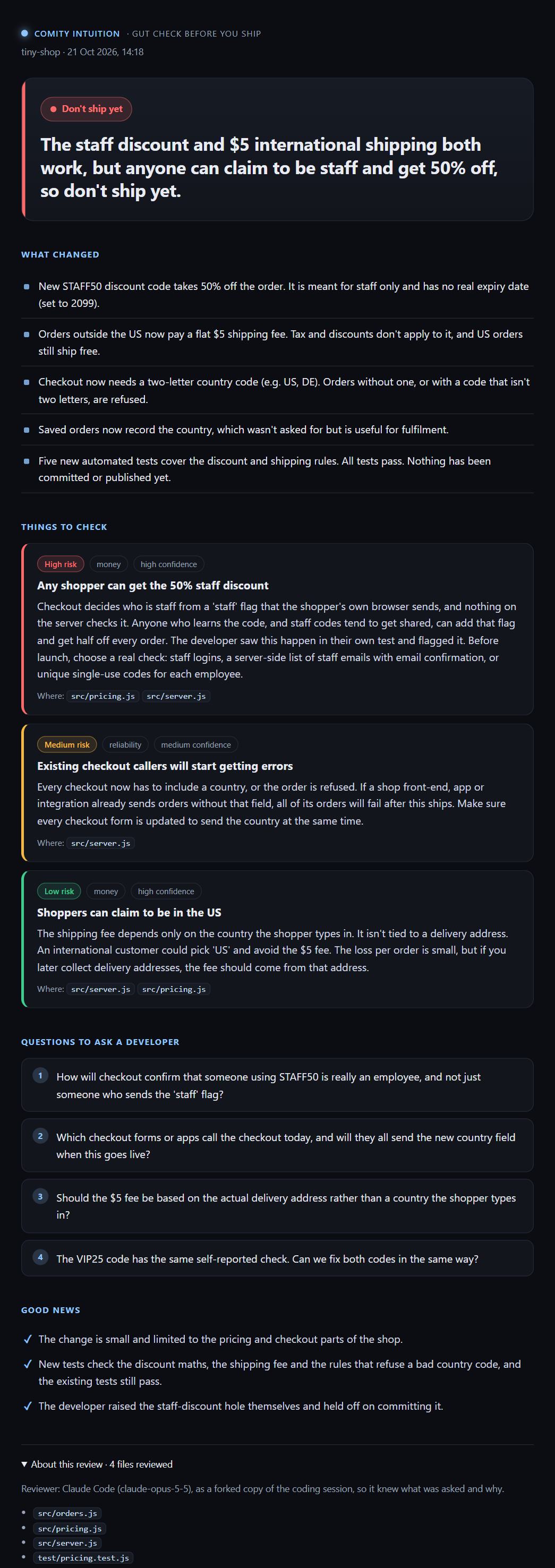
Review: ● Don't ship yet
In short: The staff discount and the $5 international shipping both work, but anyone can claim to be staff and get 50% off.
Things to check
- High risk (money): any shopper can get the 50% staff discount…
- Medium risk (reliability): existing checkouts will start failing…
Questions to settle
1. How will checkout confirm that someone using STAFF50 is really an employee?
Full report: .intuition/reports/2026-10-21T18-18-29-b22d1d.html
How it works. Because the reviewer is a copy of the same session, it already knows what you asked for, what the agent tried and why.
-
Your agent finishes
You ask Claude Code or Codex for a feature. When it says it's done, Intuition works out exactly what changed during that task. If nothing changed, it stays silent.
-
A forked copy reviews it, read-only
A copy of the session, with the full memory of the conversation, reads the changes. It can read and search files, and that's all: no edits, no commands, no internet. Your original session isn't changed.
-
You get a plain-English verdict
Your agent shows the review in the chat, close to word for word, and saves a one-page HTML report next to it that you can open or forward to anyone.
Want a second opinion?
Have another vendor's agent review the same changes in parallel, for example Codex double-checking Claude's work. A different model catches different blind spots.
npx comity-intuition config set secondOpinion codexWhat it checks. Business risks you can point to in this change, each with how sure the reviewer is and where it is. No style nits, no generic advice.
- money
Money
Discount codes that stack into free orders, customers charged twice when a payment is retried, a $100 gift card sold for $1.
- security
Security
Admin pages anyone can open, a live payment key saved in the code, a search box that lets strangers run database commands.
- data
Data
A nightly cleanup that deletes paying customers, or a database change that throws away phone numbers your reminders still need.
- privacy
Privacy
Social Security numbers copied into logs, invoices any customer can download, a customer list open to the whole internet.
- users
Your users
Changes customers will feel, like a 40%-off "we miss you" email that goes out again on every release.
- reliability
Reliability
Existing apps and forms that stop working after the change ships, and background jobs that overload the system.
- legal
Legal
Marketing email to people who unsubscribed, and other changes that put consent or anti-spam rules at risk.
- cost
Cost
An AI feature that re-summarizes every support ticket every minute and quietly runs up a large bill.
Does it actually catch things? We built a 31-case benchmark of small real-world projects: 20 changes with a planted problem, and 11 harmless changes that should stay green.
- 20/20planted problems caught by the Claude Code reviewer
- 11/11harmless changes kept safe to ship, with no false alarm
- 8/8cases passed in real Claude Code sessions, through the hook
| Reviewer | Cases passed | Planted problems caught | Harmless changes kept green | Reading grade |
|---|---|---|---|---|
| Claude Code | 31/31 | 20/20 | 11/11 | 6.8 |
| Claude Code, real Stop hook | 8/8 | 4/4 | 4/4 | 6.6 |
| Claude Haiku as reviewer | 31/31 | 20/20 | 11/11 | 7.3 |
| Codex | 30/31 | 19/20 | 11/11 | 8.8 |
Final runs of October 21, 2026 (six Codex cases come from the run just before, after Codex hit its usage limit). A planted problem counts as caught when the verdict is red or yellow and the review names the problem as a medium or high risk. Reading grade is the average US school grade level of the reviews' wording (lower is easier). Codex's one miss still came back "Don't ship yet", but didn't mention that people who had unsubscribed would get the new marketing email. Every case and every review on GitHub
100% local. No account, no server, no telemetry. It runs on the AI subscription you already have.
-
Runs on your computer
Intuition is a command-line program and a pair of agent hooks. There's no Comity server, and your code never goes to Comity.
-
No account, no telemetry
Nothing to sign up for. No analytics and no tracking: nothing phones home.
-
Your agent, your subscription
Reviews go through the
claudeorcodexprogram you already use, so your code goes to the same AI provider, under the same terms, as when your agent wrote it. -
A read-only reviewer
The reviewer can read and search files, nothing more. Anything written in your code or the conversation is treated as material to review, never as instructions.
-
Your repository is left alone
Snapshots use git's own storage and don't touch your files, staging area, branches or history. Intuition never commits or pushes.
-
Reports stay with you
Every review is saved in your project's
.intuition/reportsfolder, which keeps itself out of git. The reviewer is told never to copy secret values into a report.
Questions.
What does it cost?
Intuition is free and MIT licensed. Reviews run on your own Claude Code or Codex plan (or API key): a review is roughly one extra agent turn, and turns that changed no code cost nothing. For cheaper reviews, have a smaller model do them, for example npx comity-intuition config set claudeModel sonnet.
What do I need to install it?
Node.js 22 or newer, git, and Claude Code or Codex. Run npx comity-intuition init in your project. Using Codex? Add --agent codex (or --agent all for both) and approve the two hooks once in Codex's /hooks. Want a review right now, without waiting for the agent? npx comity-intuition review --open.
Does it slow my agent down?
The review starts when the agent finishes and usually takes 20 seconds to 2 minutes. Turns that didn't change code are skipped instantly.
Will it cry wolf?
It's built not to. The reviewer only raises risks it can point to in this change, with a concrete way things go wrong, and says how confident it is about each one. In the benchmark, all 11 harmless changes stayed green with the Claude Code reviewer.
Can the reviewer break something?
No. It has no tools that can change files or run commands, and it has no internet access. Claude Code reviewers get only read, search and list tools; Codex reviewers run in Codex's read-only sandbox.
Do I need to know how to code?
No, that's who it's for: founders who build with AI, and managers whose developers use AI agents. When the verdict is "ask a developer", the report gives you the questions to ask, ready to copy and paste.
Does it work on Windows, macOS and Linux?
Yes. It was developed and run end to end on Windows, with both Claude Code and Codex. It only needs Node.js and git, so macOS and Linux are supported too, though they haven't had the same end-to-end runs yet.
How do I turn it off?
npx comity-intuition config set enabled false turns it off for a project, and npx comity-intuition uninstall removes the hooks.
Building with a team of agents? Comity keeps every agent on your team aware of the others, and catches collisions before the code is written.
Meet Comity for teamsShip with a gut check.
npx comity-intuition initIdea credit: Aaron Gabriel Cornejo, who explained the problem he kept running into: business people need a way to know whether their AI agents' work is safe to ship.